Lasers Conduct High-Speed Busbar Stripping for EV Production
CO2 lasers efficiently strip insulation from electrical busbars, and are readily integrated into the automotive manufacturing environment.
January 27, 2022 by Coherent
随着汽车制造商准备大规模生产电动汽车(EV),其制造过程的每个环节都在不断优化。目标自然是在降低成本的同时,提升车辆的可靠性和性能表现。
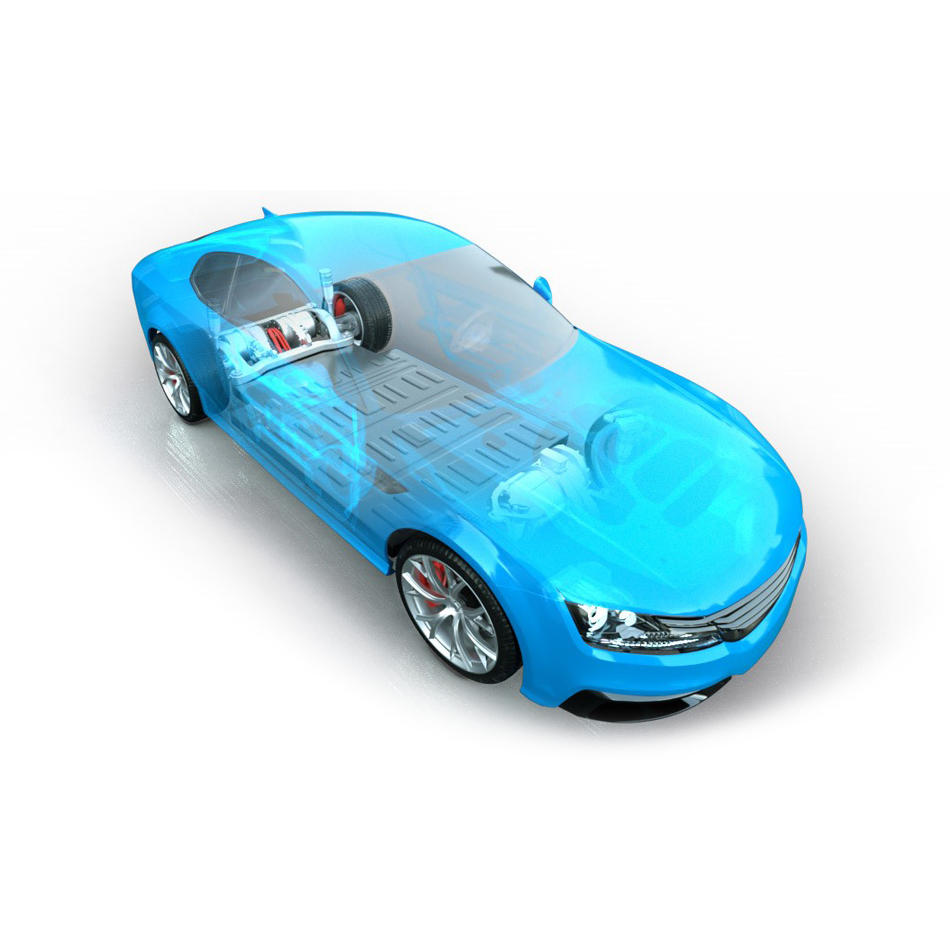
电动汽车的重要组成部分之一是将电力分配至车身的导电电缆,这些被称为母线。由于需要承载的电流强度,母线并非普通电线,而是包裹着绝缘层的宽带状金属导体(典型尺寸约为宽12毫米×厚3毫米)。 导体的金属材质多为铜,有时也采用铝。绝缘层则使用塑料材料(通常为聚酰胺PA12)。
绝缘母线材料通常像传统电线一样以长卷形式盘绕在线轴上供应。汽车制造商根据需求截取所需长度,并将其弯折成特定形状。这些形状可能相当复杂,因为母线需要绕过车内各种其他部件和结构,才能将电力输送到所需位置。
在生产过程中某个环节,必须从母线两端剥除部分绝缘层。此操作旨在实现母线与其他部件的电气连接。汽车制造商对此工艺提出了若干特定要求。
首先,剥线必须快速才能实现成本效益,避免成为生产瓶颈。这意味着仅需几秒钟就需剥除约25毫米(1英寸)的绝缘层。
其次,绝缘层必须彻底清除。因为剥离区域残留的绝缘层会干扰电气连接,从而造成能量损耗(降低车辆效率)。此外,母线端部通常需与其他导体或电池焊接。导体表面残留的塑料会污染焊缝,导致其电气和机械性能下降。
最后,导线本身不会因剥线而受损。这可能降低其机械强度,从而形成潜在的故障点。
所有这些原因基本排除了使用任何机械方法(如刀片或刮刀)去除绝缘层的可能性。此外,使用刀片从弯曲或异形表面去除绝缘层也相当困难。
激光母线剥线技术腾飞
These same requirements make lasers great tools for busbar insulation stripping. This is because the laser process is completely non-contact, and can readily be configured to work with curved parts. This makes laser processing fast and flexible.
CO2 lasers, in particular, are ideal for this task. This is because the CO2 laser produces far-infrared light. This light is very strongly absorbed by most of the plastics used for insulation, but highly reflected by the copper.
这意味着激光束会迅速将绝缘层汽化,但当接触到导体时会自动停止去除材料(因为铜会反射激光而非吸收它)。因此,绝缘层易于去除,而铜层则完全完好无损。
激光母线剥线在生产中
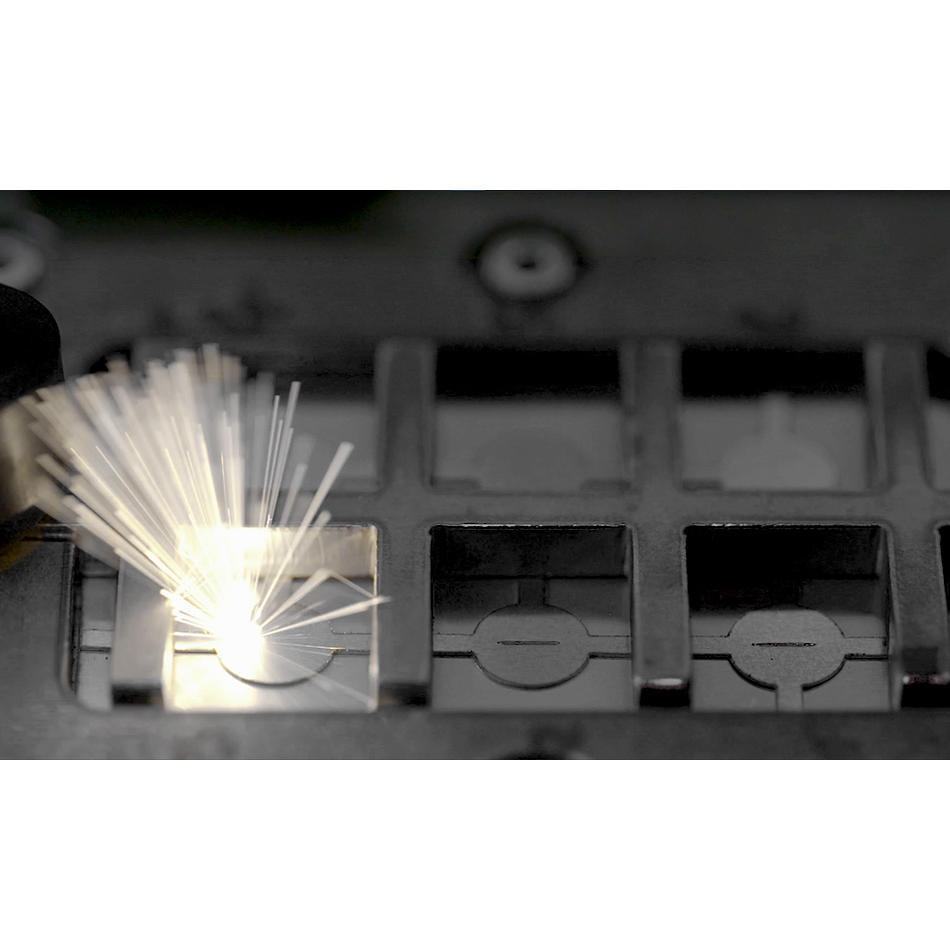
To actually perform insulation stripping, the laser beam is focused down to a small spot on the busbar to concentrate its energy. This focused beam is rapidly scanned back and forth to cover the entire area over which insulation must be removed.
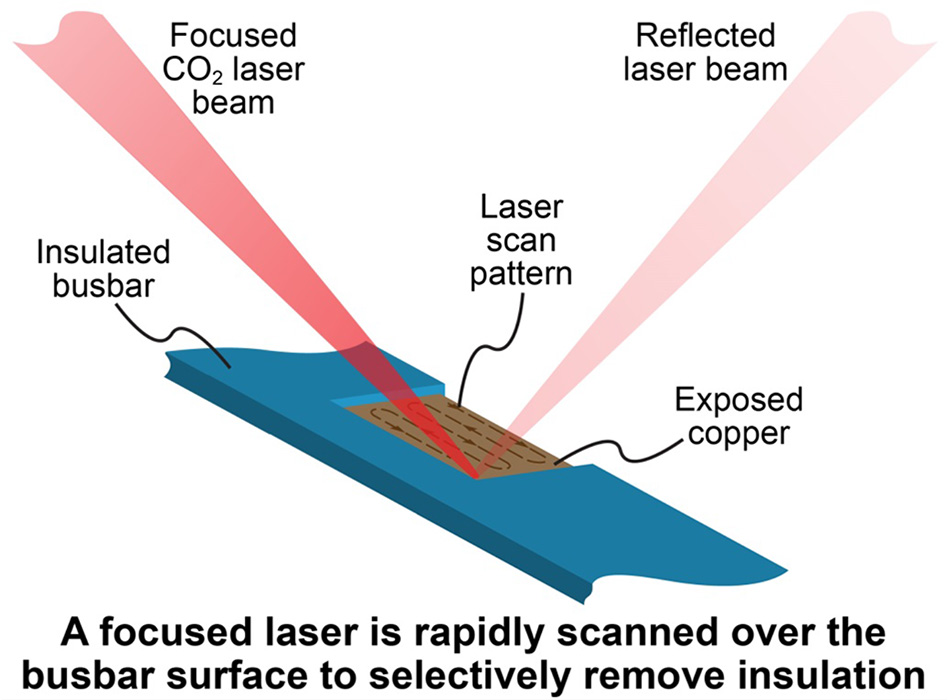
There are some important practical considerations when implementing this method in a production environment. For example, two lasers are used in order to get the necessary process throughput. Each one strips insulation from one side of the busbar (so, there would be a second laser coming from underneath in the drawing). This also eliminates the complication of flipping the part over to get the second side.
Also, it’s best to have the laser beam hit the busbar at an angle. This does two things. First, it avoids the chance that any laser light will be reflected back and damage the beam delivery system. Second, it enables the laser to remove insulation from both the top and the edge of the busbar at once (since the angled laser beam can “see” the side of the busbar).
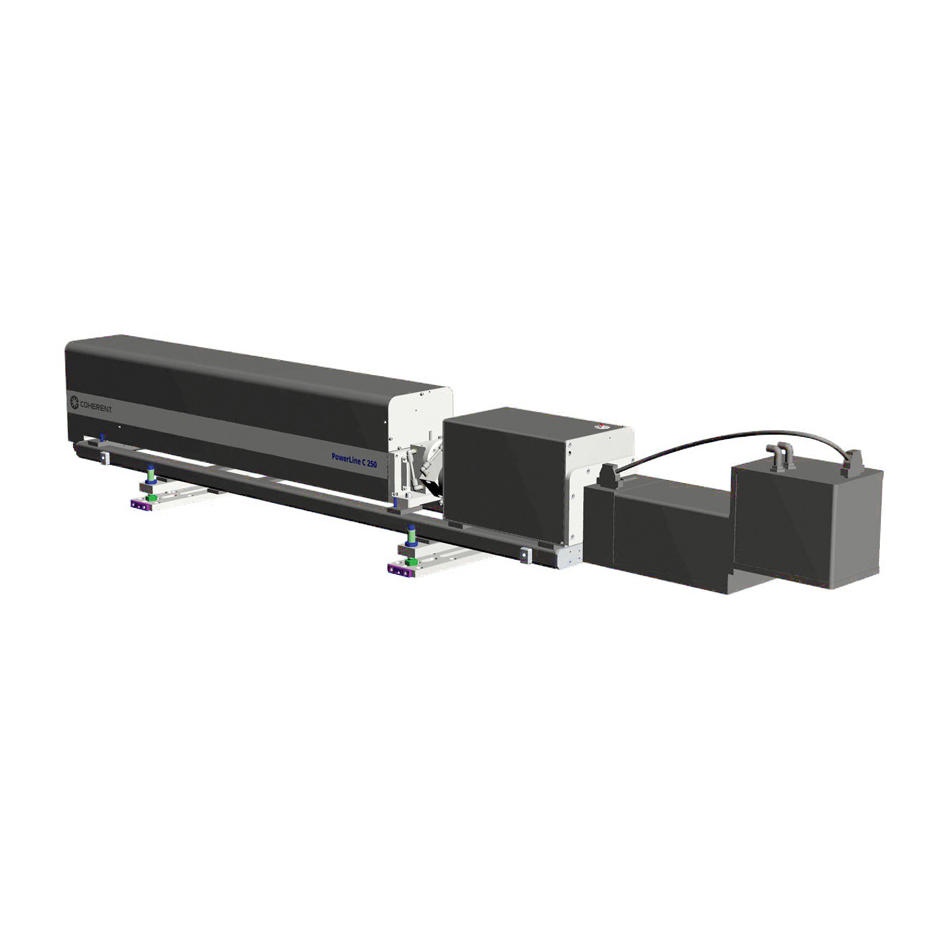
The busbar system is a complete solution for stripping busbars. It includes two PowerLine C sub-systems, and all the associated scanning and beam delivery optics, together with all the necessary control electronics and software.
The PowerLine C can remove a 30 mm length of 0.5 mm thick polyamide from both sides of a 6 mm wide busbar in about 6 seconds. Insulation removal is complete without any damage to the conductor, delivering a high yield process.
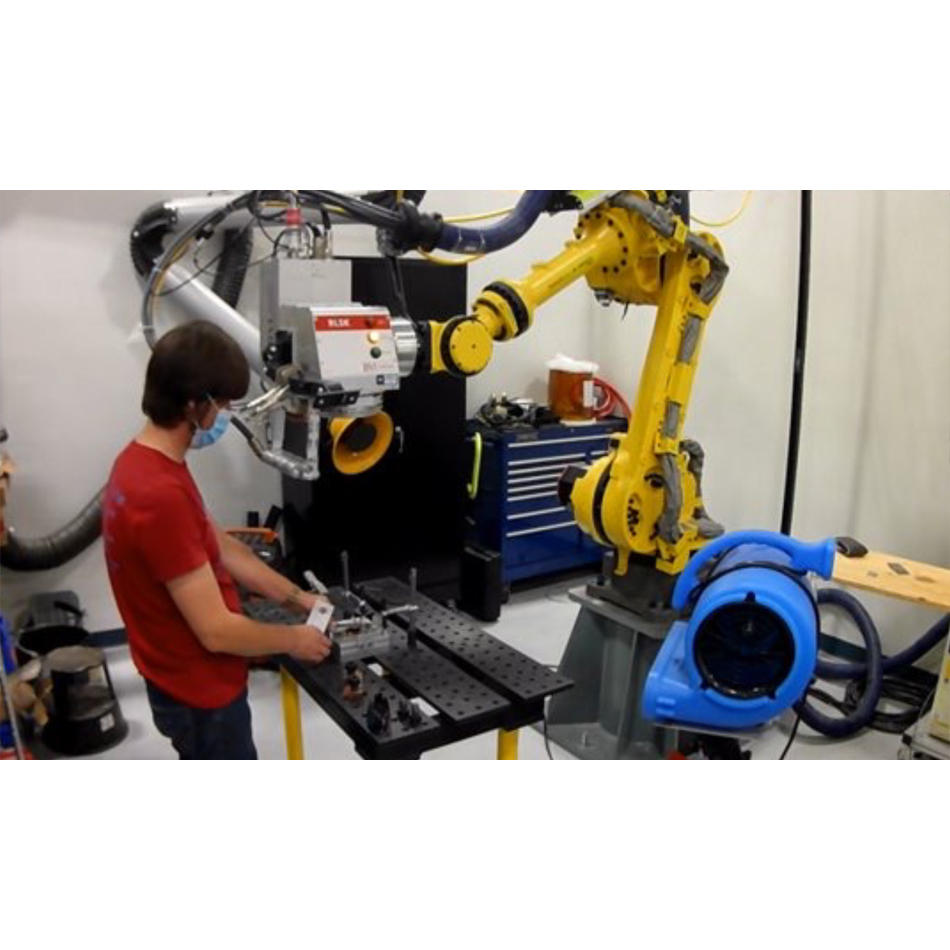
There are two different busbar stripping systems available - an inline version and a stand-alone version. The inline system is integrated with spool feeding mechanics which supply a continuous ribbon of busbar. The laser strips this prior to cutting and a final bending operation. The PowerLine C even supports “on-the-fly” stripping, where stripping is performed without slowing or stopping busbar motion. In the stand-alone version, a robot arm picks and places precut and bent busbars into the system which are then laser stripped.
观看高速高效母线剥线操作实况。
相关资源