PulseEQ:处理最精细的材料而不造成热损伤
Discover how Coherent PulseEQ technology prevents thermal damage when processing delicate materials.
July 13, 2021 by Coherent
Many products today, particularly in microelectronics and display manufacturing, incorporate materials which are thin, mechanically delicate, or heat sensitive. Lasers have become widely used for processing (cutting, marking, welding, etc.) these kinds of materials for three main reasons. First, they can produce smaller and more precise features than any other technology. Second, they impart no mechanical force to a workpiece, so they don’t introduce any stress or chance of breakage. Finally, when used right, it’s possible to limit how much the laser heats the part during processing. That’s important, because heat can damage a part or somehow change its physical properties.
热门话题
As manufacturers continue to push the envelope of what’s possible – producing more complex parts at ever-increasing throughputs – the issue of heat damage becomes even more critical. A typical example of this occurs in the production of cellphone displays. These are often based on flexible OLED modules. To produce these, multiple displays are fabricated on a large panel, and then the individual phone displays are cut out at the final stage.
这些开孔的形状可能相当复杂,包括圆角、按键凹槽,以及用于摄像头和其他传感器的孔洞。此外,切割过程中绝对不能使部件过热,否则可能会影响显示屏的外观(例如变色),甚至导致功能受损。
Because this same problem affects so many applications, laser manufacturers have been developing technology to deal with it for some time. One important breakthrough was the development several years ago of industrial ultra-short pulse (USP) lasers. These deliver a burst of light so brief that material is vaporized off the part before most of the heat has time to be conducted into it.
曲线的问题
然而,对于一些要求极高且极为敏感的应用,即便是USP技术也需要一些辅助手段,才能彻底避免对工件造成热损伤。要理解其中的原因,让我们回到切割具有弧形边角的手机屏幕这个例子。
To do that, the laser beam has to trace out the desired cut pattern on the part surface – in other words, the beam has to move relative to the part to cut out the shape you want. That can be done by moving the part on a motorized platform, or by moving the laser beam using a scanner mirror (or a combination of both).
无论哪种情况,产生光束运动的机械系统都有质量。这意味着它无法瞬间停止或启动。为了改变方向,它必须加速或减速。因此,当光束到达切割图案中的弯曲部分时,它会减速以进入弯道,然后在驶出弯道时再次加速。这就像汽车在弯道上行驶时的情形一样。
那又怎样?其实,激光器正在产生一系列光脉冲。无论这些是前面提到的超短脉冲,还是更长的脉冲,都无所谓。无论哪种情况,它们在时间上的间隔通常都很均匀——例如,每百万分之一秒一个脉冲(没错,这些东西就是这么快,甚至更快!)。
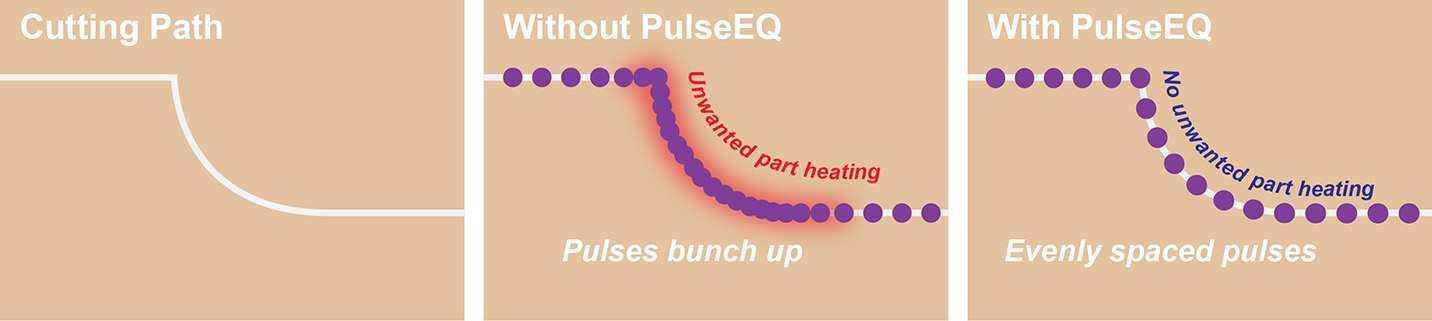
但是,当运动系统在激光以固定重复频率产生脉冲时通过弯道,会发生什么情况呢?由于光束在弯道处先减速再加速,脉冲在工件上的分布比切割直线段时更加密集。这意味着激光在该点向工件输入的热量会略微增加。这可不是什么好事。
PulseEQ 到底有多酷?
从原理上讲,这个解决方案其实非常简单。只需在切割过程中调整激光脉冲频率,确保每个脉冲击中工件的位置之间的物理间距始终保持不变,无论光束相对于表面移动得多快。
Of course, doing that in real life isn’t exactly straightforward. For one reason, when you reduce the pulse repetition rate on USP lasers, the pulse energy increases exponentially. Also, you need a control system that tells the laser exactly how fast the beam is moving on the part surface at any moment. Then the laser pulse rate has to be adjusted to match that.
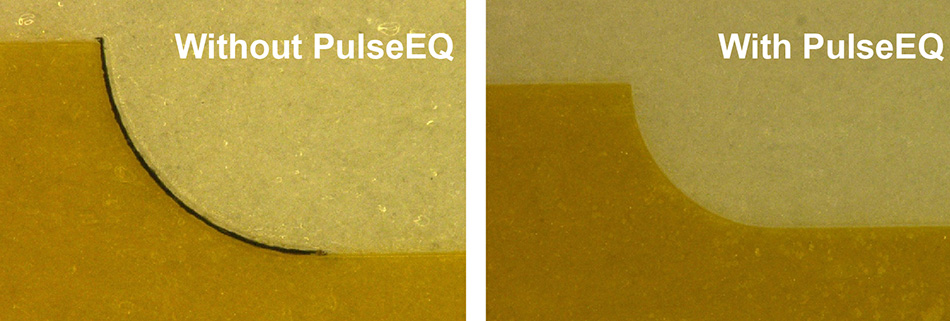
And, those are exactly the things that PulseEQ accomplishes. There’s a lot of technology that goes into making it work, and making it work precisely and reliably. But, the bottom line is that PulseEQ keeps the pulse energy constant at the desired level no matter what repetition rate the laser is operated at. And, it allows the laser repetition rate to match the part motion. So, no matter what the scan pattern and scan speed looks like, the laser cutting power at the work surface always remains the same. This enables the laser to perform the most precise and demanding processing tasks without producing any heat damage to the part.
Because PulseEQ helps Coherent lasers deliver the best possible results in so many different applications, we’ve made it available on all of our industrial USP and nanosecond lasers.
相关资源