客户成功案例
高意 Ultrafast 是多光谱拉曼组织成像的关键
挑战
科研 是在科研 术中活检等未来的临床应用科研 ,振动成像的最终目标都是生成具有充分光谱信息的快速(即最高可达视频帧率)三维图像,从而实现详细的化学图谱绘制。科研 成像过程无需标记这一特点在科研 同样具有实用价值科研 临床前应用中科研 至关重要。
自发拉曼显微镜是一种强大的无标记成像技术,但其信号非常微弱,这限制了其成像速度和灵敏度。受激拉曼散射(SRS)可将信号放大数个数量级。但SRS通常仅在一种或两种离散频率下进行,只能实现基础成像,例如区分富含蛋白质或富含脂质的区域。 意大利米兰理工大学的Giulio Cerullo教授及其同事致力于将SRS显著扩展至多个(初期为32个)波长通道。为此,他们需要一套激光系统 1微米波长激光系统 速激光系统 ——该波段水分子不吸收,且通过多光子吸收对DNA造成光损伤的风险极低。
解决方案
They decided to build an SRS excitation laser system around a 10 watt Coherent ultrafast laser for several reasons. First the output is at 1040 nm, in the desired window for tissue imaging. The high power is important since the beam is used in part as the SRS pump beam and in part to drive a home-built optical parametric oscillator (OPO) that generates the broadband SRS Stokes beam. In addition, SRS is a third-order optical effect that is thus very power-hungry. The laser’s high (80 MHz) repetition rate is also important as it enables high-speed scanning with dwell times as short as <50 µs/pixel and fast modulation. The fast modulation is key to the detection side. For this, the team uses a photodiode array followed by a unique 32-channel lock-in amplifier chip. This is synchronized to fast (2 MHz) modulation of the pump beam. (Coherent helped at the planning stage by carefully measuring and confirming the ultrafast laser noise was particularly low at this frequency, enabling high signal-to-noise and, as a result, faster scanning.)
结果
Cerullo研究组已成功证明,该系统能够对光谱密集的样本进行详细、高空间分辨率的成像。他们通过对32个SRS波长通道进行光谱拟合,成功区分了异质样本的化学成分,具体方法是测量培养肝细胞中两种不同脂肪酸在单个脂滴层面的相对浓度。此外,他们在纤维肉瘤的临床前小鼠模型中成功识别了肿瘤边缘。 此外,他们最近通过采用最新的高功率(18 W)高意 Ultrafast ,进一步提升了系统的性能。
注:米兰理工大学在其卓越的科研工作中使用了多种高意 型号。“鉴于我们成像方法在光学和电子方面的复杂性高意 ultrafast 激光器 的高可靠性和操作简便性激光器 其关键优势。”
—朱利奥·切鲁洛,意大利米兰理工大学物理学教授


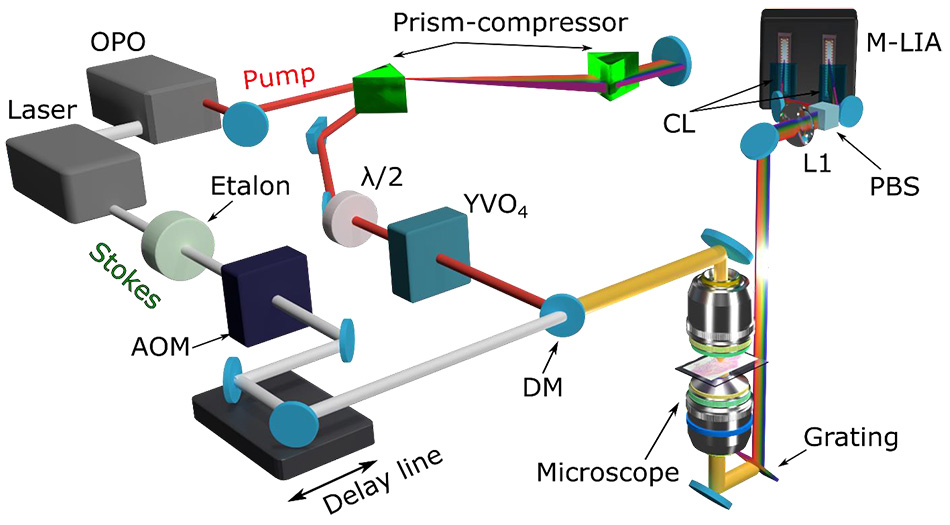
图1:基于多通道锁相检测的宽带SRS振动成像。Cerullo研究组开发的光学实验装置示意图。
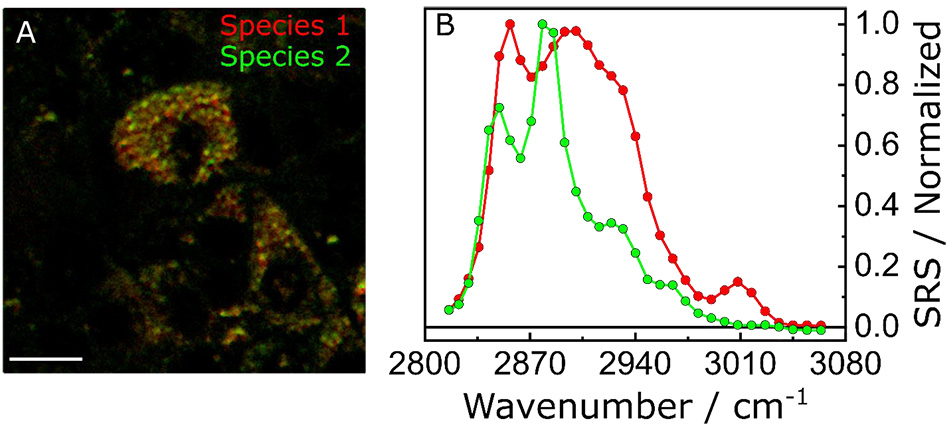
图2:小鼠肝细胞的光谱分辨图像,显示了两种不同脂质类物质的相对浓度分布。