白皮书
新型材料助力实现千瓦级法拉第隔离器
KTF 是一种磁活性晶体,与 TGG 相比,其热效应显著降低。这使得光学隔离器在高功率激光系统中能够具备更长的使用寿命和更优异的性能。
Faraday isolators are one-way valves for light. They are often placed at the output of lasers and amplifiers to protect them from any light reflected back by downstream optics or surfaces. If this returned light re-enters the laser, it can cause output instability or even damage.
Faraday isolators rely on a magneto-active crystal; this is a material that, when placed in a magnetic field, will rotate the orientation of linearly polarized light. Terbium Gallium Garnet (TGG) has long been the standard magneto-active material for Faraday isolators operating in the visible and near IR spectrum. However, as the output power of industrial lasers continues to scale up, TGG’s inherent absorption and thermo-optical properties become increasingly disadvantageous. This can ultimately make the Faraday isolator the performance-limiting optical element in the laser system.
Now, Potassium Terbium Fluoride (KTF) has emerged as an alternative magneto-active material. It overcomes the limitations of TGG and can successfully operate at much higher laser powers. This document provides detailed information on the properties of KTF. It also reviews test results from a new series of Faraday Isolators intended specifically for high-power lasers – the Coherent Pavos Ultra series – that incorporate this material.
TGG及其局限性
TGG has long been the Faraday rotator crystal of choice for the 650 – 1100 nm spectral range for several reasons. For example, it can be grown with high purity. It has a high Verdet constant (a measure of the strength of its Faraday effect) and its cubic crystal structure and low intrinsic birefringence make it easy to achieve high polarization extinction without the need for sensitive alignment processes. And it is relatively low cost.
然而,即便是最纯净的TGG,也会因其体吸收效应而面临性能限制。这种吸收会导致晶体内部局部升温,从而引发三个主要的性能限制因素。
首先,偏振旋转量会随激光功率的变化而变化。这是因为晶体的韦尔德常数会随温度变化。随着晶体升温,它也会加热周围的磁体,从而改变磁体的性能。结果导致隔离性能下降。
A second issue is thermal lensing. Since the crystal is typically held within a large permanent magnet, the crystal is difficult to cool directly. A Gaussian beam within the crystal produces a radial temperature gradient which causes a refractive index gradient. This has a lensing effect which is power dependent and will shift the focal position of the system. If the lensing is strong enough or asymmetrical, it can also reduce beam quality.
另一个问题是热诱导双折射,这同样是由材料内部的温度梯度引起的。它会影响透射光的偏振状态。这不仅会降低隔离器的性能,还会影响依赖偏振的下游光学元件。
这三个因素共同影响着功率稳定性、光束质量以及工作表面上的聚焦光斑位置。这些因素都会直接影响加工结果,从而可能降低工艺一致性并缩小工艺窗口。
侧边栏
How Does a Faraday Isolator Work?
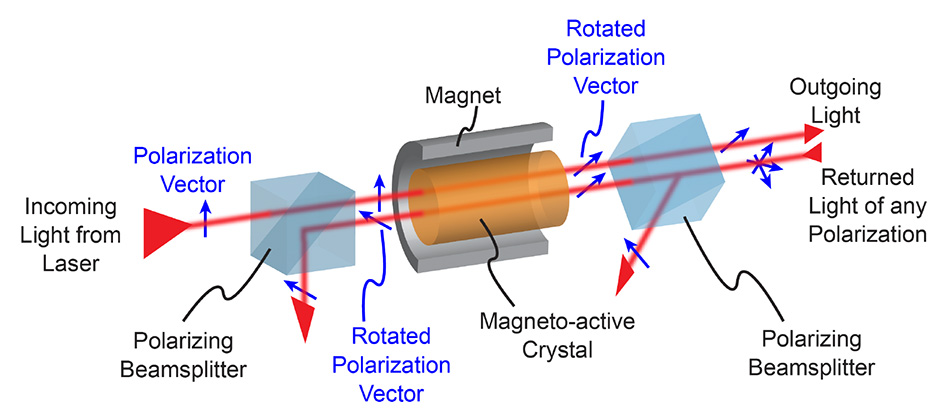
法拉第隔离器的原理简单易懂,如图所示。线性偏振光(从左侧入射)先通过一个与光偏振矢量方向一致的偏振片。随后,光进入处于磁场中的磁活性晶体。该晶体使光的偏振面旋转45°(这是法拉第效应的结果)。 光束穿过另一片与旋转后的偏振方向对齐的偏振片,随后通过光学系统射出并进入工艺流程。
从该系统或过程反射回来的任何光首先通过一个偏振片,该偏振片会阻挡任何与原始隔离器输出方向不一致的偏振光。经过滤的光随后通过磁活性晶体,并再次发生45°的偏振旋转。这使得其偏振矢量与第一个偏振片呈直角,从而阻挡剩余的反射光。
KTF及其优势
KTF 的透射范围与 TGG 相似,其韦尔代特常数也与 TGG 相当。最重要的是,与 TGG 相比,它的体吸收系数(低八倍)、热光系数(低 15 倍)和应力光系数均更低。这些特性共同作用,使其能够避免 TGG 法拉第隔离器在承受高激光功率时所面临的光隔离性能、光束聚焦和光束质量下降的问题。
然而,KTF早期的生长尝试所制得的单晶棒存在气泡、夹杂物以及高散射等问题。这些晶棒在透光率方面并未比TGG有实质性提升。
幸运的是,随着工艺的不断改进,如今已能以更低的成本生产出更高产量的优质 KTF。因此,KTF 有望在高功率法拉第旋转器和隔离器中取代 TGG。
Pavos Ultra 系列实验数据
Coherent Pavos Ultra Series Faraday isolators based on KTF have now undergone thousands of hours of lifetime testing with near-infrared, kW-class lasers. These tests clearly demonstrate that it delivers excellent isolation and beam quality, while maintaining performance over a long, continuous lifetime of use as required by industrial laser manufacturers.
The first graph compares optical isolation – the key performance metric of an isolator – as a function of laser power for TGG and KTF isolators. While TGG performs better at the lowest powers, its performance rapidly degrades as power increases. The stable performance of the Pavos Ultra isolator over the measured power range means that it can be relied on no matter how, and how long, the laser system is operated.
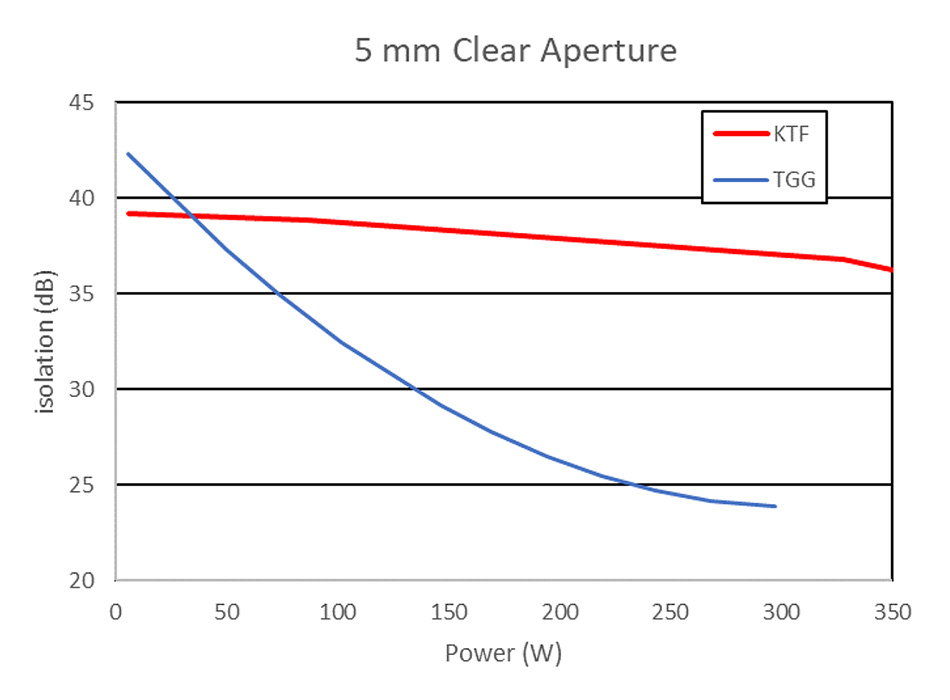
图1:KTF和TGG的隔离性能与激光功率的关系。
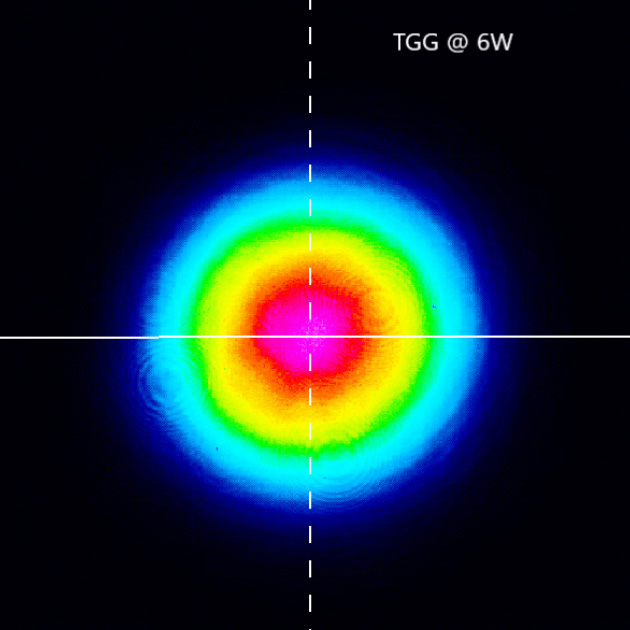
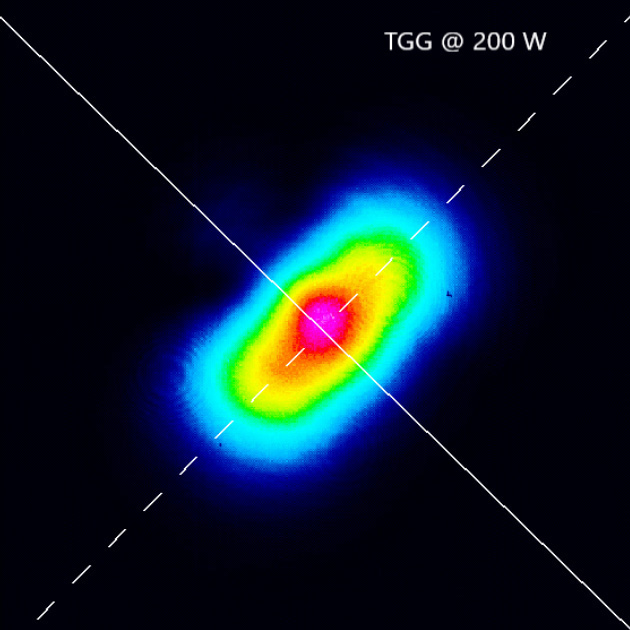
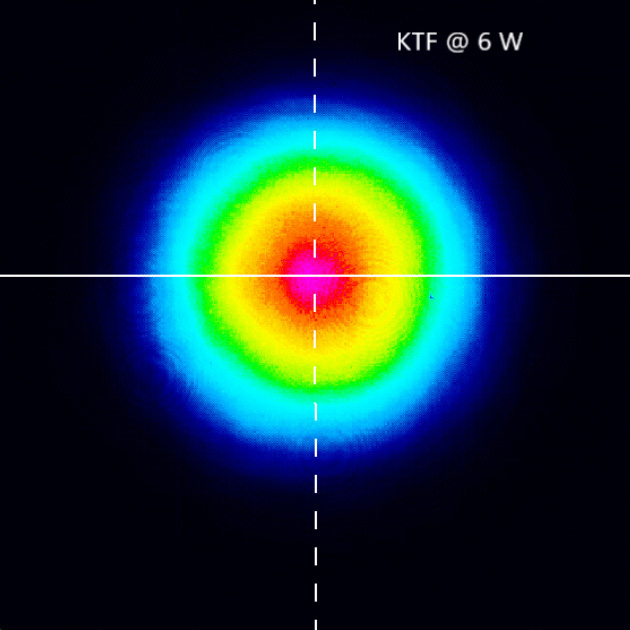
与基于TGG的隔离器相比,KTF隔离器还能保持更好的光束质量。这一点在两种隔离器的光束剖面测量结果中得到了验证,这些测量结果分别对应6 W和200 W的功率。
隔离器类型 |
6W |
200W |
TGG |
 |
 |
Pavos Ultra (KTF) |
 |
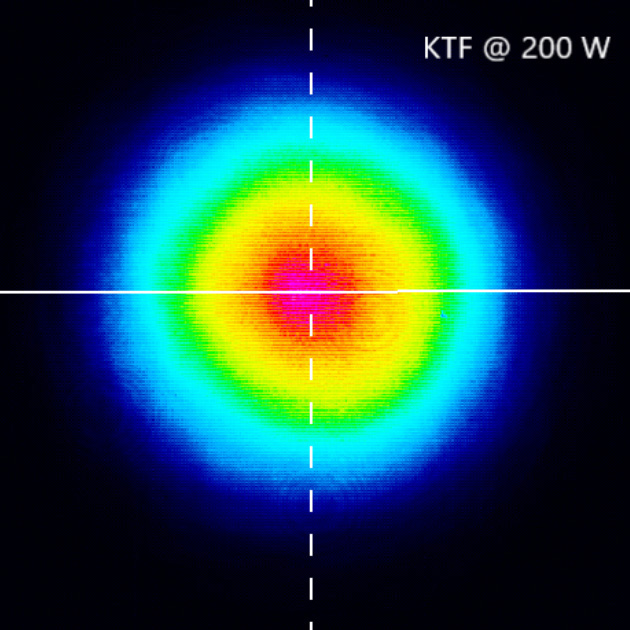 |
图2:KTF和TGG中光束轮廓随激光功率变化的情况。
M² 指标为光束质量提供了一种更具量化意义的衡量标准。该指标通过将被测光束的强度分布与理论上完美的正态光束进行比较,得出一个比值。下图对比了 TGG 和 KTF 隔离器的实测 M² 值。显然,在测试的功率范围内,Pavos Ultra 隔离器的光束质量几乎没有下降。
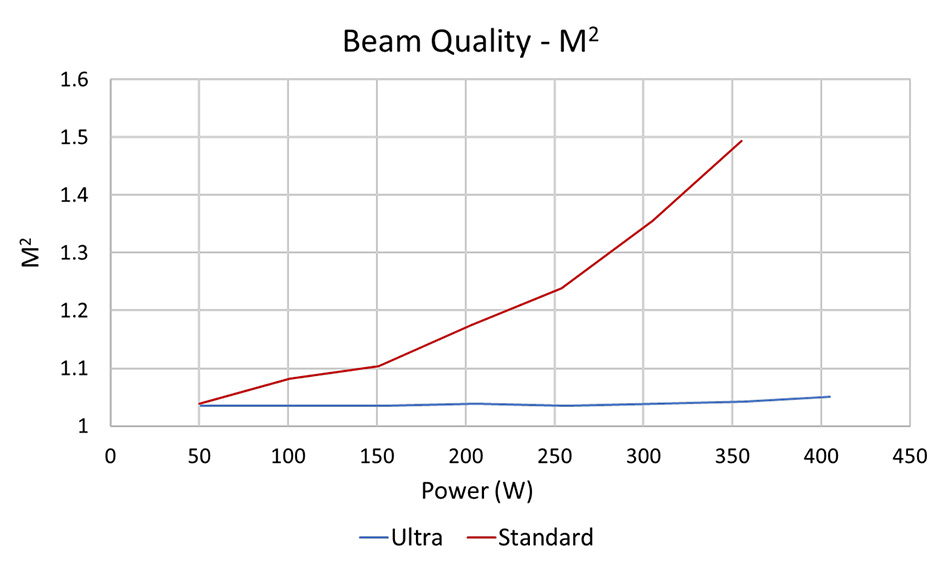
图3:KTF和TGG中光束质量与激光功率的关系。
Focal shifting is one of the most significant problems with using Faraday isolators at high power. This is because even if the laser system continues to operate without damage or even instability, a focal shift can degrade process results.
Even though the thermal conductivity of TGG is an order of magnitude higher than for KTF, experimental results clearly demonstrate significantly lower thermally related focal shifts and better beam quality when compared to TGG at equivalent power levels. Test results are provided in the next graph.
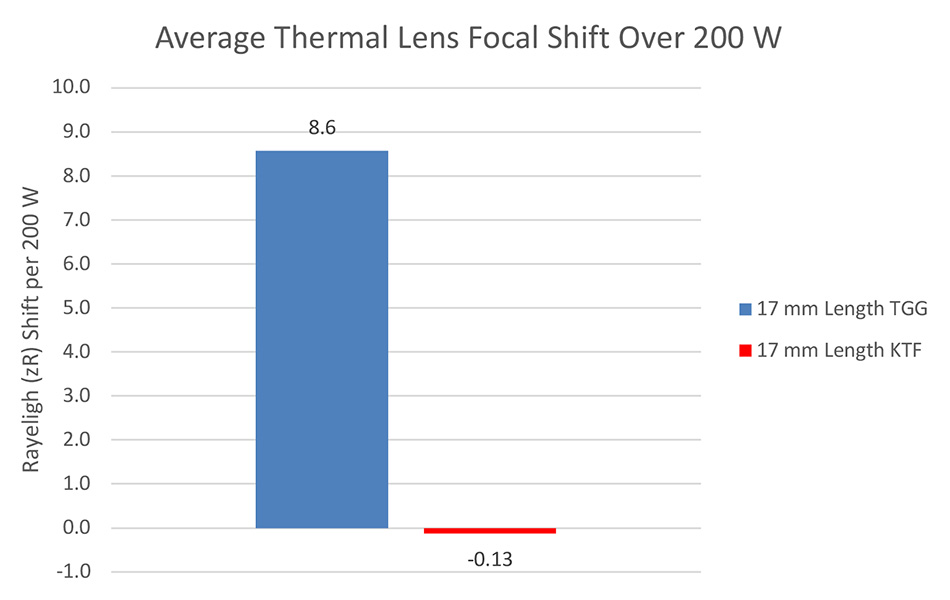
图4:KTF和TGG隔离器在200 W激光功率变化下的焦距偏移。
图中未显示的是,KTF 引起的微小焦距偏移也是线性的。这意味着,测得的偏移量很可能可以外推,从而得出更高功率水平下的预期焦距偏移。
Another important point to note from the last plot is that KTF demonstrates a negative focal shift. Specifically, beam divergence increases with temperature, as opposed to the self-focusing which occurs in absorbing optics with a positive shift.
This can actually be beneficial when KTF is used together with other positive shifting optics (such as fused silica components). Specifically, the negative shift of the KTF will partially compensate for the positive shift of the other components, resulting in a lower net focal shift for the entire system.
For instance, the Coherent 4 mm aperture PAVOS Ultra isolator uses two fused silica polarizing beamsplitter cubes and a KTF crystal. Each beamsplitter has approximately a 0.3 zR/kW focal shift. The KTF crystal has an average focal shift of -0.6 zR/kW. The result is generally a negligible focal shift for the complete isolator.
The long-term performance of Coherent PAVOS Ultra series isolators has also been examined. Specifically, these isolators were tested within prototype laser cavities at Coherent over usage intervals of 1800 – 3000 hours.
入射到 KTF 晶体上的功率为 2.7 kW,光束直径约为 800 µm。这相当于功率密度略高于 130 kW/cm²。图表显示,在整个 1800 小时的测试期间,腔体始终保持稳定。 所有波动或变化均源于对 KTF 旋转器以外的其他系统组件的调整。要维持这种稳定性,光束质量必须保持恒定。
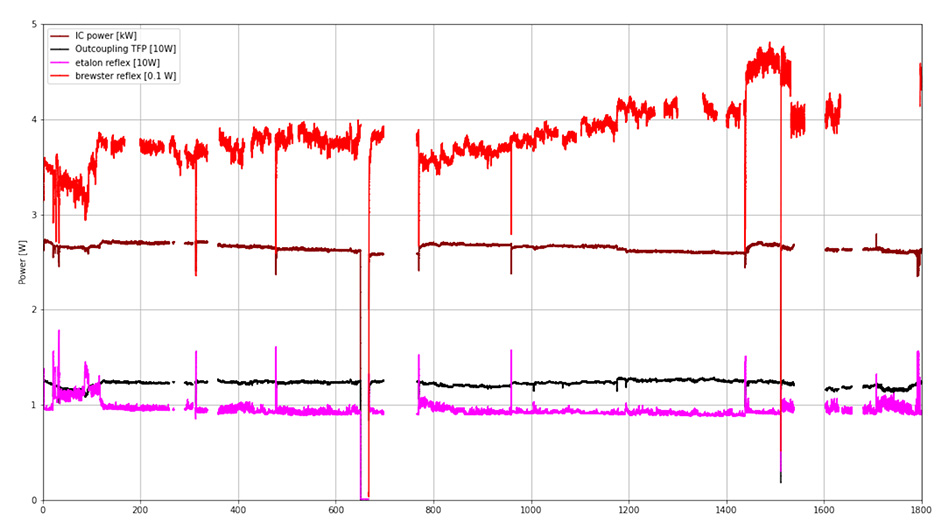
Figure 5. Long-term operating stability of the KTF-based Coherent Pavos Ultra isolator when exposed to high laser power.
结论
While TGG remains the first choice magneto-active crystal for lower-power Faraday isolators and rotators, its inherent absorption and thermo-optical properties limit its use with higher-power lasers. By adopting KTF as the new standard for high-power Faraday isolators, laser manufacturers will be able to remove the constraints imposed by TGG and focus their efforts on improving performance in the rest of the system.